Suitable Specimen Types
- Faeces
Specimen Transport
Usual to laboratoryTurnaround Time
7 working daysSample Stability
Upon receipt store sample below -18̊C ready for extraction. Extracted samples are stored between 2-8̊C prior to analysisCalprotectin (faecal)
General Information
Calprotectin is a protein found in cells involved in inflammation. It is present in abundance in neutrophils. The concentration of calprotectin in faeces is increased in inflammatory bowel disease and has been shown to be a better marker of the disease activity (seen on tissue biopsy) than blood test markers of inflammation (e.g. white blood cell count, ESR and CRP). Its measurement is relatively cheap, non-invasive and it is stable in faeces at room temperature for several days.
The main diseases that cause an increased excretion of faecal calprotectin are Crohn's disease, ulcerative colitis and cancer. Levels of faecal calprotectin are not raised in patients with irritable bowel syndrome (IBS).
Patient Preparation
>Random faecal sample (any time of day, no dietary restrictions required) in a faecal collection container and approximately 1 gram in weight.
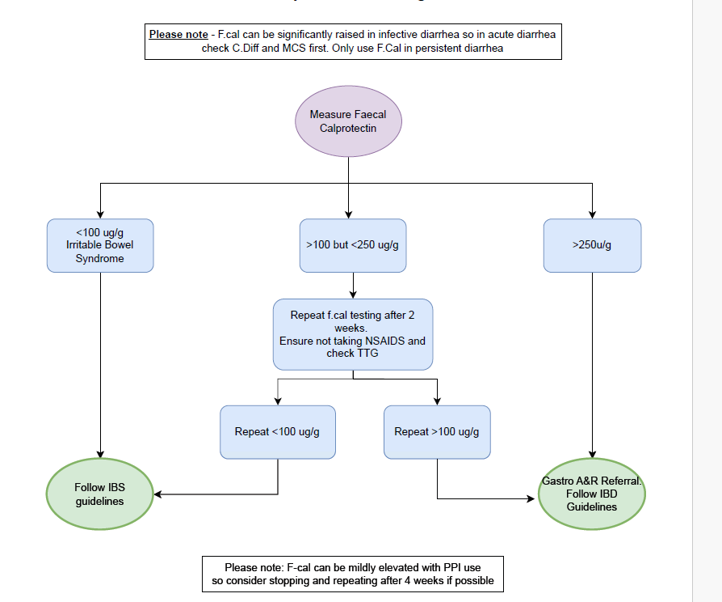
NSAIDs/PPIs may falsely raise faecal calprotectin. If initial result is intermediate, suggest stopping these medications for two weeks prior to retesting.
Reference Range
Clinical Cut offs (New Guidance in place 16/07/2026)
Adults (Individuals 16 and over)
FCAL <100 ug/g : Not indicative of GI Inflammation. Consider IBS or alternative diagnoses.
FCAL 100-250 ug/g : Indeterminate. Suggest repeating in 2-4 weeks if clinical concern remains or relevant family history. NSAIDs/PPIs should be stopped 2 weeks prior to sample collection. If repeat result also indeterminate suggest referral.
FCAL >250 ug/g : Indicative of GI inflammation, suggest referral.
Paediatrics (children <16 years old)
FCAL <50 ug/g - Not indicative of GI Inflammation
FCAL 50-150 ug/g : No further action needed. Consider repeat if symptoms worsen.
FCAL 151-250 ug/g : Indeterminate. Suggest repeating in 4 weeks if clinical concern remains or relevant family history. NSAIDs/PPIs should be stopped 2 weeks prior to sample collection. If repeat result also indeterminate suggest referral.
FCAL >250 ug/g : Indicative of GI inflammation, although false positives can occur in patients with high BMI. Suggest referral.
Source of Reference Range
Agreed with Consultant Gastroenterologists to be used in in conjunction with local guidelinesSpecifications
- EQA Scheme?: Yes